Rated AI
Interview with lee Normus
5/12/2025
MM: Hello. Thank you so much for doing this interview. You are Lee Normus? (or Lee Johnson) which do you prefer?
LN: That's fine.
MM: I first saw your work in a group show with The Reno Generator at the Reno-Tahoe International Airport. You also have a studio here at The Generator and you participate in a punk rock flea market, which I've heard is very popular. And now, you have a solo show with us at the Reandy Warhol Diaries Gallery. Has your involvement in the local arts always been this broad? You mentioned maybe no. And if not, what has influenced you? What is driving you to be active in such a wide range of venues here?
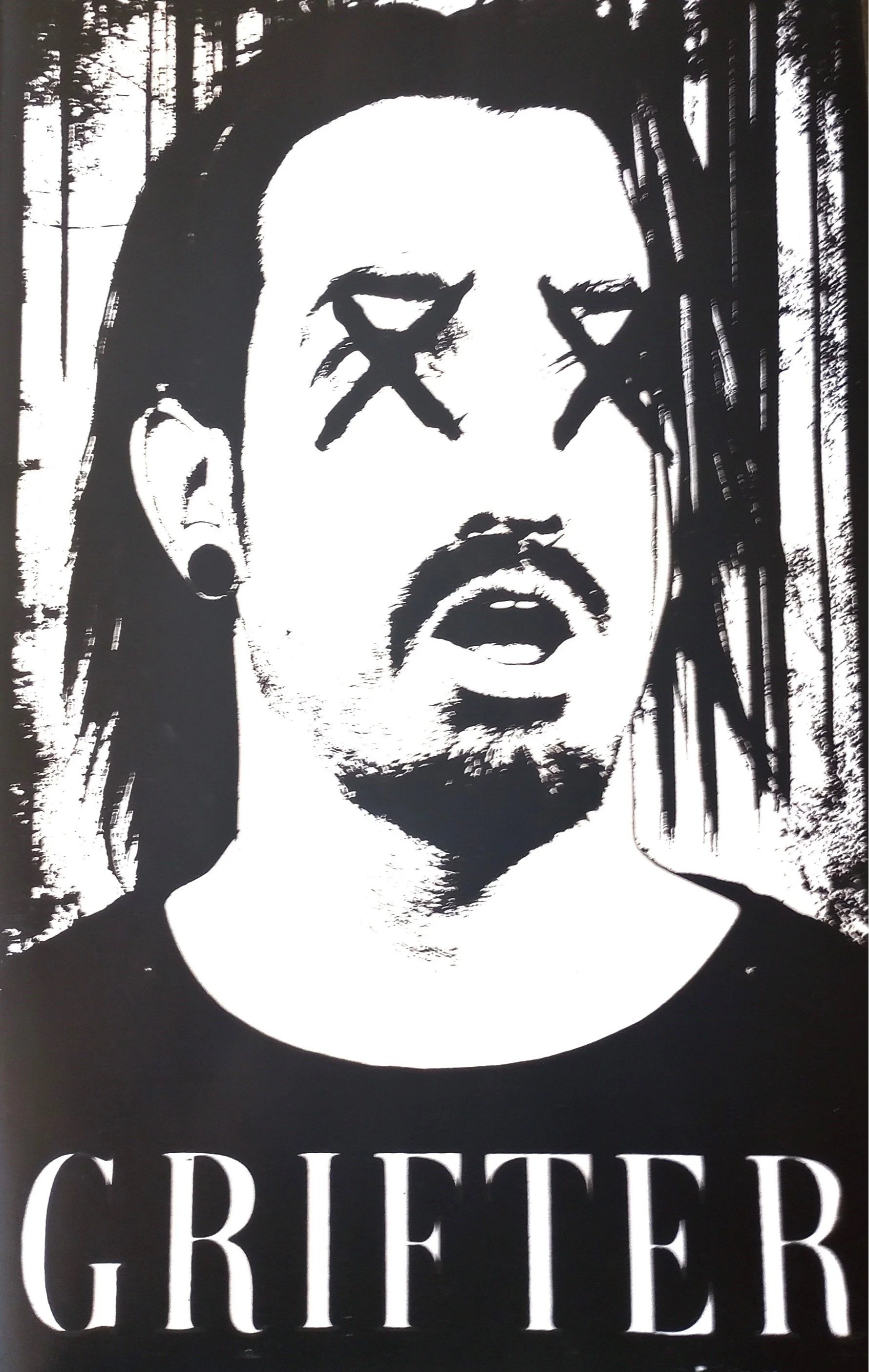
LN: I don't think I've never been this involved in the arts and I never really even considered myself an artist. I have always done like, work for people in graphic design, making flyers or doing their t-shirts. I did some website design, but I just got really into it after I was diagnosed with end-stage renal disease, kidney failure. And I just decided that, you know, I wanted to do more of this stuff for fun and for myself. I guess, you know, that's not entirely true either. Like I've been a vendor at the punk rock flea market, like you mentioned, for a number of years now, probably seven or eight years. But even still, that for me had always been about making stuff to sell and some kind of income source rather than just like art for art's sake. But I just started making art for art's sake and not necessarily for any type of money. But I I'm just really into it and I like screen printing and I was able to get a show with you and really kind of do something bigger on a larger scale than I've ever done before. And I think it turned out pretty good.
MM: Yes, the show at the Reandy Warhol is phenomenal. When I first saw your work at the Reno-Tahoe in the group show (I think I mentioned this), that I had definitely thought your work was exceptional, even in terms of the group and I took a picture your work with the intent of you doing a show with us. But then when I saw the finished zebra installation prints, I was blown away. It looks like Rodeo Drive. There’s an aesthetic value to those prints.
LN: I thought it was a fun idea.
MM: OK, so you grew up in Las Vegas. Do you want to talk about that?
LN: That was where I was born and raised. Kind of. I grew up as a little Mormon boy and then got into, like, sales and telemarketing in my early to mid-20s. I did really well doing that. I was a pretty slimy kind of guy, like just really money motivated at the time. And it was, you know, it was good. But I like who I am now better.
MM: This might be a little out of your scope of interest, you know, but when I was studying art, Las Vegas was always a very important subject in art theory, especially in the 90s, because it dealt so much with the artifice and, you know, like the smaller scale Paris or the smaller scale New York and that became the theme park that is today the Las Vegas Strip, which, you know, is what it is.
LN: Yeah, it's art in and of itself. Right? Like immersive--super immersive.
MM: Immersive. That’s a good way to describe it. I wouldn't have used that description.
LN: Well, it just sucks-you-in, all the interaction. And even the way they set-up the casino is meant to, like, get you lost. And like they pump oxygen, to kind of keep people high and they keep it cold so you move around and they hide the doors on purpose.
MM: So you stay up all night gambling?
LN: Well, but that's the immersion, right? Yeah. And people want you to have a good time doing it.
MM: You're right. Exactly. You don't want to fall asleep from boredom.
LN: But yeah, the colors, the lights, the sounds. It's an amazing place.
MM: Given that the Las Vegas model is so large in scale, I had to wonder if it had any type of influence on what you're doing now?
LN: Probably so. Like, I don't know. I can't put my finger on how. But like it definitely fuels my cynicism, especially growing up there. Especially being Mormon in Vegas. People don't know that it was originally a Mormon fort? It was a Mormon town. Every high school there has a Mormon church across the street. And it's just interesting. The juxtaposition of like this religious upbringing and very conservative values against the sin city and the lifestyle and everything that drives that city. But, you know, like a lot of things about Vegas. It's still my home in my heart. But I like to see for myself how far I've grown from there. Even though I was super successful and in a lot of ways, I was? man, I was super cool. I had a good life there, but I like who I am better now. And I like the direction I'm going.
MM: Do you think it's because approach to your work is more “authentic”?
LN: Yeah, it probably has less to do with Vegas. Like I am jaded from my experience in the health care system and just decided I don't want to participate in the normal “whatever” and just do what I want to do. And I've made that decision. I'm an artist and I'm a musician and I do artist and musician stuff.
MM: I'm going to jump a little further ahead on my list of questions. You mentioned your use of AI to me when we were installing as if to “confess something”. Can you cite a specific example of why you thought using AI was controversial? Or was it something you simply thought was important to mention to me? Do you think AI has some inherent contradiction to what you said about liking yourself now?
LN: I really embrace AI as a tool. Even if there's a kid out there or somebody that's using it to create the thing that's in their head that they can't draw. Now they have a way to get it out of their head. And even though it was artificially generated for them. It's an idea starter, something that sparks the imagination. I've always used it to take apart or to remix things in multiple ways of my own. And that's what's fun for me. “How do I say this?” I mean, especially like if I imagine a kid using it, they can make a full movie by themselves with AI. They could do all this stuff and people are telling them, no, it's wrong. It's not real art. It can't have a heart because AI made it. I'm not saying this right or wrong. They can make whatever they want and they don't need anybody to tell them what to do. And the tools are all there for us to be self-sufficient. And I think the people that that are really railing against it, what they're mad about is that that their ability to earn income from it. But that's not a problem with art or the artist or the people using AI. That's a problem with the world as a whole. And the forced lifestyle that we are at gunpoint to live or we can't exist. And people are saying, oh, man, I want my jobs back. I want I want my capitalism back. I'm not worried about it taking my job. I feed the machine my art. I feed it my music. I'm not afraid to remix and use it. And I think it's great. I don't know. I hope I said that right.
MM: Yes. It was clear.
LN: Yeah, I mean, use it as a tool. It didn't hang it on the wall. I applied it to what I saw in my head and made it work. And for the most part, I'm just going to keep making stuff you know, that's what I do.
MM: Now, I usually ask this question--since I moved to Reno, especially and it's kind of a generic question. I ask everybody about their involvement with the Burning Man and Black Rock City. The event?
LN: Yeah.
MM: AutoCAD? It appears as though they produce a lot of the work here. Don't they? Do they use the same tools?
LN: There’re hundreds of art pieces out there in Black Rock City, and some of them are made here. And it's a good place for people who are traveling from afar to make the work and be fairly close to ship it instead of shipping it from New York or Australia or wherever they're coming from.
MM: So it's a global event?
LN: Yes. They come here and we'll rent the space and they’ll build their thing.
MM: I would imagine using those large-scale models. I mean, how?
LN: To set up the city.
MM: You just went as a fan?
LN: There's so much that you can do. You can go as a camp and interact that way. Some camps set-up bars and have their own little oasis bar where they serve booze and a special drink. Some places cook food and serve food to people. Some camps are like a car wash. Where you go and with a bunch of naked people get your body washed. And then there's the Orgy Dome.
MM: They actually have an Orgy Dome?
LN: Yeah, there's a lot going on out there.
MM: Okay, well, that's interesting.
LN: There's skateboard parks and bands play. I saw the Alan Parsons project out there. It was amazing.
MM: I was mentioning the new movie to you--and I don't want to make this about the Reandy Warhol Diaries Gallery, but I was worried about the but the upcoming movie project, the ratings and the type of response to it here in this part of the country. I wanted to remake “Liquid Sky” but that isn’t PG-13. And as you said, you know, there’s an actual Orgy Dome. I had second thoughts about doing this next project. As artists we have to self-censor but not due to an R rating.
LN: We were saying earlier, too, you're going to piss somebody off no matter what. And everything's so divided. You just do what you want. And like some people love it. Some people hate it. And like if they hate it, like that's really them loving it.
MM: I don't even think of it as like it or dislike critically. I mean, like a new morality. Like censorship the way films have to be re-rated now. NC-17. Warhol would have been NC-17 now.
LN: Like that's all that's good publicity, right? They're professional people that are just like they're doing consensual things. Doing drugs and going out and having fun. That's good.
MM: I am very much an outsider to “the Burners”? (laughs). I still don't sound cool when I say it.
LN: “Burner”, yeah. And now I go out there and I know people from all over the world. They go there yearly and it's cool to go. In fact, how I started going to Burning Man was the same way. Like around the same time as I started with the punk rock, vending at the punk rock flea market. About eight years ago, we were vending out in Empire, Nevada, right outside of Burning Man. And I had never been before. And I didn't like the people. I was like, oh, a bunch of dirt hippies, you know, like going to their Orgy Domes. And then you get into it. And then I went and it's so much more. And it's just people getting their little freak-out on. Like not even sex or drugs necessarily, but like it's their little time to go around half naked in their summertime attire.
MM: You mean, experiential. I gotta go.
LN: It's worth going and seeing. There's something for everybody.
MM: I know that the art itself--some of the most important critics in New York review Burning Man and it makes the Art Review there regularly--the press, there. Serious art critics do acknowledge it as important as an artform.
LN: It's incredible. It's like to take the drugs out. If that's not all there is, the drugs and the alcohol and the sex, then the art out there is incredible. And even beyond just the art that's displayed out in the playa, like the art that everybody brings and the immersion of that, all of it. The whole thing is one big immersive art piece. It's like a post-apocalyptic world, but everybody's thriving, you know, with fluorescent lights and blinky bikes.
MM: Do you think that Reno; Nevada is like that? Like a concrete platform or assimilation of the same concept?
LN: No, because just having come from Vegas, even there, it's still very weirdly conservative. It's like controlled vice. And especially now since the pandemic, it used to be everything was open 24 hours and you could go out all hours of the night. And it just really isn't like that anymore. There is a really cool art scene that's coming out in Reno because a lot of the Bay Area used this as their hub to go gamble. But now around the country, you know now there’s the Native American casinos and whatnot, anywhere you go. So they can get that elsewhere. So Reno's kind of trying to like become more of an art city. There's a lot of people pushing it forward, like the neon district. Like there's a lot of the big art that's made here goes up on out there, (Black Rock City). But there's this balance of like, yeah, they're doing a lot for the community. And as long as it's with good intention, “I don't want to be this guy to be like, don't come here, California”. It's bringing all the people from California and kind of gentrifying. And in the meantime, they're chasing out all the stuff that they're moving here to like consume. All the art and the culture. People aren't able to afford it during and after the pandemic.
MM: I want to leap to another subject that you just made me think of. I heard that UNR is having Hot August Nights on campus this year. Brian Sandoval is heavily involved in getting GSR involved, you know, the basketball they want to develop for the university.
LN: Yeah.
MM: So it didn't surprise me that Hot August Nights will be on campus. So the weirdly conservative aspect of this town I never factor in that it's a college town. Do you think that there is any kind of juxtaposition there worth looking at?
LN: Yeah, I mean, like, but they're the college privilege of that's probably where the most rowdy stuff in the city comes from, right? And like fraternities and a lot of the--I don't want to like, make an editorial piece, but it's very “good old boy”. And like a lot of those people came out of that college. They went to school out here together. They run the cities and were in fraternities and sororities and stuff together. They are very much like connected to the city and “who's who” in town. That's how I think it is everywhere. But I think the conservative aspect of it is being so close to the capital here, Carson City.
MM: Right, and that's a good point. I don't mean to berate you with like infrastructure questions. But you mentioned the thriving arts scene or the emerging arts scene here and I came from New York City where you're up against, you know, the same type of conservative or provincial criticism.
LN: You know, the gatekeepers.
MM: Well, that would be my next question. I wanted to know how you came up with the show’s title, “No Gatekeepers” and is that like no police or was that coming from a socioeconomic perspective like a class distinction or all of it?
LN: I think stuff that happened recently, on a more like personal level for me, that I had something to do with it, but it's also about just even the way that people gatekeep each other for crumbs for the for the rich and the elite. They will be the gatekeeper. Like say you call customer service to get your $25 back and they tell you no, or you will wait hours and hours for finally somebody at the top to tell you that yeah, I'll give it back to you but now you've wasted all this time when they could have just given it back. And the people that are put in front of you to block you are just $13 an hour-employees who have some power in this world and we'll just they love it. And like we just do it to each other we gatekeep each other and we just need to let people live as long as you're not hurting anybody let people do whatever they want. I believe that I'm kind of an anarchist and gatekeeping wouldn't really work for me.
MM: Here's like kind of a generic dumb question. How did you become interested in screen making specifically? Why that is your medium?
LN: It had to do with just a hustle at first. Like how to make some money. I was into website design. And that was probably the better hustle because it didn't cost me money. I didn't you know, I mean, there was little things and fees to host it but I got into shirts because I had the access to the equipment. I had a business partner that was making shirts and eventually I just started doing it myself. I would just make my own side money and kind of hustle. And I was doing it a lot for businesses or bands. And now I just like to do it to for the art of it and for myself.
MM: The zebras definitely do not depict somebody who was on a hustle at any time in their life. They're very empathetic. I really interpret the zebras on a visceral and emotional level. Do you have any insight into why you think that piece is special?
LN: For one it looks cool like it's cool that's visually. A lot like going on to fall into (that category) but it definitely does tie in to the “No Gatekeepers” and about things being very black and white. And then, the little framed ones with the colors, speak to how there's more to it than just black and white. Everything's not black and white. It's a full spectrum. And from there you can expand on that theme. How you will? There's multitude of ways. I like that it can be taken multiple ways and I like to hear what other people like about it. But it was definitely a lot about judgment and just doing what you want. And even in a black and white world, like, just live in full color.
MM: Now if you were to rate your show, like NC-17, PG-13, like what would you rate it? Like suitable for all audiences?
LN: I have one of Jesus Christ that says, “fuck the world”.
MM: I know, but it still seems so childlike--so innocent.
LN: At the punk rock flea market, I put that one pretty much up front and center. And like, yeah, I mean, it draws the attention of all kinds of people. Not in like a bad way necessarily either. It's something that that makes them think. Yeah, I think it's suitable for most ages. There’re some people who don't like it. Or might not even get it. Or like, their interpretation might be even darker than some of my stuff.
MM: You said it makes them think. And then you use AI. Do you think it's the AI that's navigating that type of thought? Or do you think it's your design that's making them think? Are you and AI collaborating?
LN: I feel like it's a collaboration with something that I can communicate. If I was comparing it to working with people who have let me down or when I'm working by myself, they're not always there to like, work with me. And AI is something that I work with. And I think that I can get my ideas out with it. I really like to put my idea up and organize it the way I see it in my mind. I think it's a gift. It's the universal consciousness. It's something that we can draw from. And I think that's what we're going to be using it for. If you have fun making a funny little pit, garbage-pail-kid picture of yourself, or like, what do you call it? The little doll, the little action figure one, like have fun, like, life's too short. It's too sad. It's too fucked up. Like, have fun. And keep making stuff. That’s what is Andy Warhol said. He said, you know, it's not for you to decide whether they love it or hate it and just keep making stuff and let them decide. And, and I think I'm making things like I don't really care. I like it. I like what I do.
MM: And the zebras are truly a breakthrough.
LN: Thank you so much. That means a lot.
MM: Is there anything you wanted to add in closing?
LN: No, no, not really.
MM: Thank you, Lee Normus.