The Benghazi Precedent: Hillary Clinton’s lasting legacy
By Monica Moran 10/8/2026
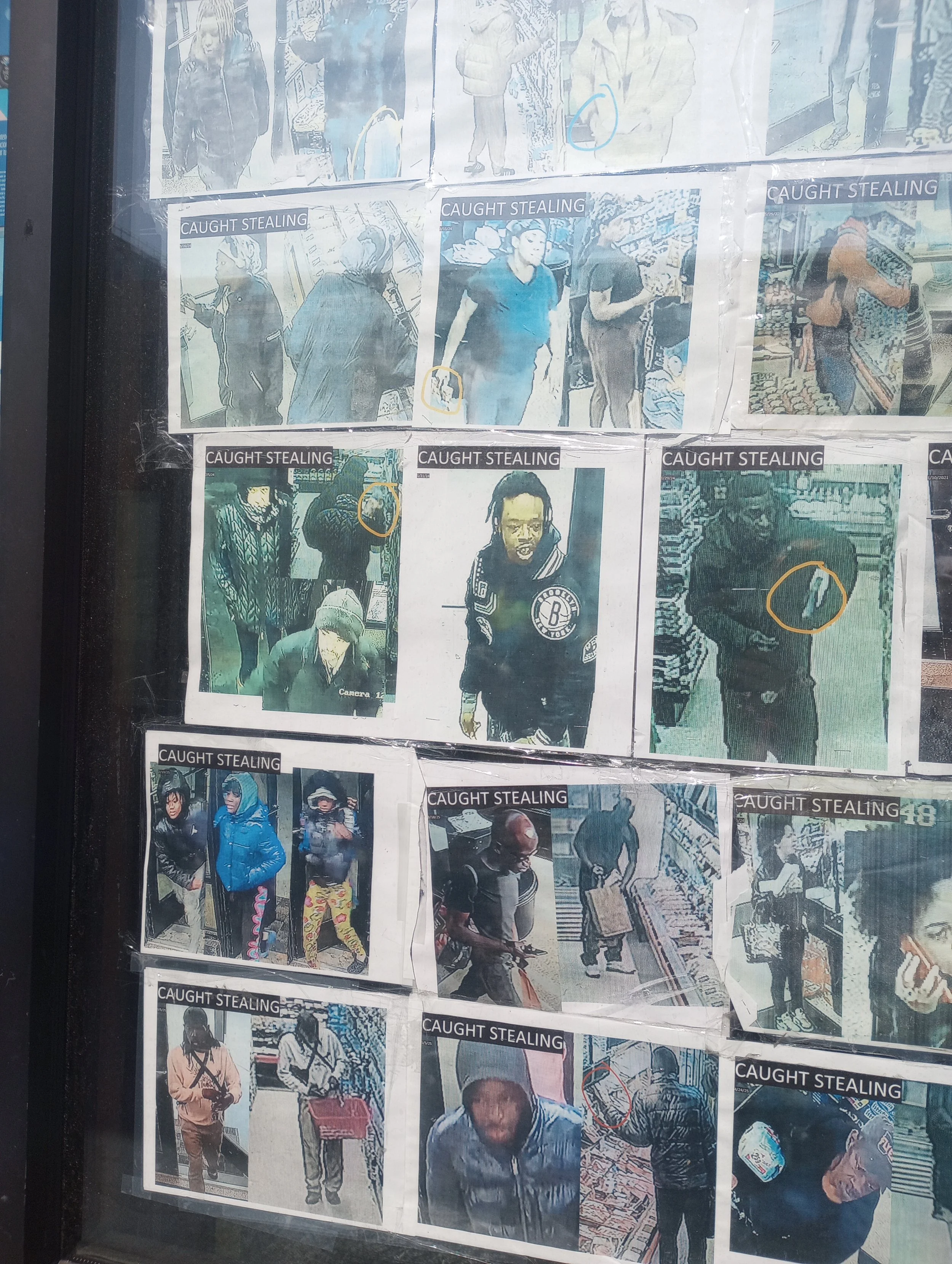
SuperFresh grocery store window display of customers who were restricted from reentry. New York. Photo by Monica Moran 2026.
With the rise of the mega project; such as the Las Vegas Sphere, which utilizes environmental controls, narrative controls and neurotechnology, the need for a legal framework presents in the shockingly new set of human rights that are literally partially enacted in the United States (The U.S. "MIND Act" Proposal (September 2025): At the U.S. congressional level, the introduction of the Management of Individuals’ Neural Data), as well as Canada and the South American groundbreaker, Chile.
The laws focus on reforming neurorights and are primarily concerned with brain data and protecting the privacy of the mind. However, among the leading concerns is the subjects' identity (on a global scale). The legal acts are based on the potential for commercial neurotechnology, such as Muse EEG headbands and BCI’s like Neuralink; to gain unauthorized access to braindata; however, some of these mind readers are limited in terms of the reality of the ideaspace and rely on interpretation.
Establishing a new global standard for human rights seems outside the scope of most U.S. legal scholars and much of the legality already relies on HIPAA regulations under the guise of medical technology. The FDA (Food and Drug Administration) oversees approval of medical devices. The MIND Act passes regulation to another agency, the FTC (Federal Trade Commission). Since the consumer products do not fall under that category and present an ethical dilemma which can be echoed in the “show trial” of Hillary Clinton who testified before the House Select Committee on Benghazi in 2015. The Clinton testimony focused more on narrative which is among the key concerns of neurorights groups. Narrative is a driver for many other multi billion dollar projects to be completed by 2030 are in areas of interest for US foreign policy.
Everyday explanations
Use of personal data obtained by commercial technology and targeted personalized marketing are among factors that contribute to institutional violence. But do they fall under the category of neurorights?
Amplification of private conversations and personal medical data through security breaches on commercial telecommunications devices is more commonplace than ever before.
In fact, access to private conversations and public reconfiguration of narrative is something that secretary of state Hillary Clinton has been publicly scrutinized for numerous times (in 2015 for Benghazi and 2016 for her email controversy) subsequently shaping foreign policy and diplomatic relationships during her time in office.
She talks in-depth about the intelligence that was used to configure those narratives within the department of defense. However, the average consumer of commercial technology and social media use faces an interpersonal challenge within the public square. I actually stumbled upon the 2016 proto awards honoring the best narrative experience. So this adaptation of personal data isn't necessarily a new development. However, the requirements of a legal framework are.
These mega projects have caught the attention of neurorights groups based in many major universities such as Columbia and Cambridge and larger companies such as Neuralink and Synchron who make larger claims than just narrative and identity interoperability. The companies claim that their neurotechnologies are capable of recording or even altering neural activity. In the era of generative and agentic AI, enterprises no longer just manage human workers therefore the growing need for ethical reform that addresses the idea space with both legal and transparency concerns.
The most basic platforms
The scenario recalls a recent incident at New York University where on December 1, 2025, at around 9:22 AM, Amelia Lewis, a student on her way to class (wearing noise cancelling headphones) was assaulted and pushed to the ground by repeat offender.
But were her neurorights infringed upon? Was she forcefully prohibited from attending class?
Similar scenarios are present in public libraries, particularly in large cities.
The neurotechnology may or may not have been present in the NYU assault, but the attack was recorded. It appears as though the student was being targeted and followed by the group. There is a reason such an attack might be recorded and stored for later use.
Activities such as these can now be used to train robotics models such as Tesla’s Optimus by using a method called imitation learning such as recording a person’s behavior and actions. They can then be translated into basic digital signals for robotics commands like color-sorting or simple object kitting. However, advanced robotics uses cognitive AI driven systems that might need an applied narrative. The University as an event space for the same type of recording may be another concern, particularly for Columbia.There is an ongoing battle in upper Manhattan about access to College Walk that has been off limits as of 2023 due to expectations of presentation related outcomes due to the war in Gaza.
The research indicates that there is a need for evidence based legal narratives since AI cannot demonstrate how or why they reached a particular conclusion. Reiterating that the secretary of state emphasized during the hearing, “I’m sorry if my statements do not fit your narrative”. For those who recall how aggressively she was questioned on the Benghazi attack.
But are narrative rights neurorights? And do ethicists believe much of the legal framework will depend on defining what that means? Even simpler explanations such as social media trends and the availability heuristic present within any interpretive lens must also be taken into account when defining legal action.
A list of some practical concerns might include poor representations of persons and their characteristics such as generalizations of cultural and gender archetypes. The use of the media ecosystem such as with generative AI. Dissociative symptoms such as when a sense of identity is fragmented and the mind compartmentalizes memories, unique traits, names and hyperpersonalized content, among others.
A disrupted concept of self can occur when mirroring and other psychological techniques are imposed on public spaces. In Clinton’s case, the hearing transcript states, “Egyptian prime minister, I said that this was a claim of responsibility by Ansar al-Sharia by a group that was affiliated or at least wanted to be affiliated with al-Qaeda.”
One prone to align oneself with a group or another person is a key factor in neurorights concerns and begins to segue into other legal complications regarding familial structures. These identities are within the scope of familial discussions and identifications that can lead to legal definitions particularly in cases of marital rape and criminalization.
Monitoring online activity can be seen as a prototype of thought. Algorithms and saved search histories can be organized into a cognitive map for what the user may be thinking about. And in cases of legal intervention, there might be a call to action but these claim to occupy the ideaspace as well, as in the case of Ansar al-Sharia.
Legal filings designed to accommodate the ideaspace as it exists creates a series of problems and conflicts of interest and are among the growing list of neurorights concerns. These associative identity displacements raise another question, concerning the assault on the NYU student.
Did the perpetrator in the NYU assault think of himself as a husband of the student? Or within mutual consent? Was she listening to a song or was she wearing noise canceling headphones? Did he self-identify with any number of those factors? Fact from fiction has extremely blurred lines with regard to identity which is why these legal issues begin to matter in cases of interpretive spaces such as neuropsychology. With regard to legal challenges that involve both identity and sexual assault, regional gaps and marital rape are of great significace in terms of outcomes. For instance in South Asia (Bangladesh and India) and several Arab States marital rape is usually not criminalized.
But a growing number of countries do define rape around the absence of consent rather than requiring proof of physical force or violence. Which is likeminded to neurorights. Nations like Sweden, the United Kingdom, Germany, and Iceland recognize that lack of consent defines the crime which also accounts for psychological responses.
However, bearing in mind the secretary of state's testimony and observations of the eagerness to claim those attacks. Reporting the events sometimes do compound the problem for that reason.
The email controversy
Regarding her use of a private email server, federal agencies and the FBI did classify a portion of the emails because they contained sensitive diplomatic communications; however, brain data is defined as sensitive data according to neurorights groups and how to classify that data is among their leading concerns. Most of Clinton’s legal challenges were difficult to follow for that reason; an abysmal understanding of the technology that that department of defense was using in 2008 when her email server was originally installed during her presidential campaign.
What is a private AI server? And was one available to the Clinton household in 2008? And what is the difference between a private AI server and a private email server (Clinton was said to have used)?
An email server is a physical computer or hosting setup configured to deliver electronic mail (emails, contacts, and calendar invites). It is also for storing and routing text-based correspondence between parties.
An AI server is a high-powered computer system equipped with specialized hardware (GPUs or TPUs) designed to run and train artificial intelligence models on LLMs (such as machine learning algorithms). It can also generate text, make automated predictions, rather than simply sending emails back and forth.
A consumer-grade model such as that did not exist in 2008 however, the first lady may have had access to a military grade prototype before the consumer release during President Clinton's time in office. The MIT Artificial Intelligence Laboratory did make an appearance at the Clinton household in 1993. Clinton’s Presidential campaign had won an award for using an information service developed at MIT for a 1993 campaign technology project.
Some features of neurotechnology when applied to criminal justice
Neuroprediction, utilizing brain scans (EEG) to predict a convict's likelihood of reoffending in order to dictate sentence length, is one legal concern. Another example is using brain fingerprinting to “extract memories”. However, brain fingerprinting is not universally accepted or admissible and the new laws are said to be a safeguard against such a standard for forensic proof in courts. These unregulated admissions such as P300 EEG testing to detect “guilty knowledge” is considered coercive testing and such testing violates a person’s absolute right to refuse neural mapping. Legal scholar, Dr. Jan Bublitz stated that one has a “right to forget”. His coauthored publication, A Duty to Remember, a Right to Forget? Memory Manipulations and the Law is a relevant topic and Dr. Bublitz has done several intervention projects based on augmented memory as well as BCI. Admissibility and interrogation as a legal strategy, particularly with regard to neurodata, could fall into a new category if a national standard were sought under the FTC.
However states such as California, Colorado, Connecticut and Montana already have state-level biometric protections. The MIND Act is proposing a national standard of their use. There was a landmark legal precedent regarding the admissibility of statements gathered during the interrogation with regard to Benghazi.
Benghazi navigates complex rules regarding the admissibility of evidence captured in a foreign conflict zone. Intelligence reports not collected through traditional law enforcement chains. Statements obtained by military or intelligence personnel rather than the FBI. Is very much the same type of bait and switch with regard to FDA/FTC regulations.
The Benghazi trial also used digital forensics retrieved from an unregulated, active war zone in post-war Libya.The future of the mega project will likely have to incorporate this legal framework into its infrastructure. But there are legal scholars Dr. Bublitz [1] is among them, who believe that new human rights laws are excessive in that the laws already in place protect the biological brain as an organ and that a scaled neuro-legislation will create extra or special conditions for brain data that is ambiguous and applies to neurotechnologies that do not currently have capabilities described such as memory extractions.
The transcript from the Benghazi hearing mentions the non-existence of components within the events that took place such as “a video”.
Chairman (continued): An eyewitness in the command center that night on the ground said, “No protest, no demonstration. The attack starts at 3:42 Eastern time. Ends at approximately 11:40 p.m. that night. At 4:06, an ops alert goes out across the State Department. Says this, “Mission under attack. Armed men, shots fired, explosions heard.” No mention of a video, no mention of a protest, no mention of a demonstration.
Secretary Clinton (continued): the video that night in a very specific way. I said, “Some have sought to justify the attack because of the video.” I use those words deliberately not to ascribe a motive to every attacker but as a warning to those across the region that there was no justification for further attacks and in fact during the course of that week we had many attacks that were all about the video.
In conclusion I can re-anchor the video’s main subject (e.g., a brain-computer interface demo) and identify which of the five core neurorights are most at stake.